Light of a Clear Blue Morning
This must be the best part of the year surely? The chill of an early morning gives way to the pleasant warmth of a midday sun, replacing the searing heat of summer. For now, the blue skies remain faithful and the jumpers stay tucked away in their drawers. We can look forward to Celebrity Traitors and can once again enjoy the “will we, won’t we” debate about Strictly.
Just as summer inevitably gives way to autumn, autumn will eventually yield to winter. The clouds will thicken and skies turn grey, the dark evenings extend and the seasonal cycles continue to roll on.
Whilst changing seasons are predictable, markets are not. In previous Strategy notes, we wrote about the need to balance optimism with prudence. This still rings true. We had hoped for steady progress and that has fortunately come to pass. This has not been without some bouts of volatility though, and with rising concerns out there, this is a pattern we anticipate continuing.
Strong investment in artificial intelligence in the United States and defence across Europe continues to support company earnings and economic activity. At the same time, higher oil prices are creating renewed inflation concerns and raising questions about the path of future interest rates. Against that backdrop, we are maintaining a careful and disciplined approach to portfolio management.
Central Banks: Because one of us was wrong
Oh, what must it be like to be a central banker! The challenge of navigating the interest rate environment since the global financial crisis has seen more thrown at the stewards of monetary policy than is kind to mention. They have moved from supporting economies with very low interest rates to fighting the sharp inflation that followed the pandemic and energy shock. Today, the challenge remains how to balance above target inflation when economic growth is not especially strong.
That gives central banks a difficult balance to strike. Raise rates too far, they risk weakening economies further. If they do too little, they risk allowing higher energy prices lead to increasing wage demands that could feed through into more persistent inflation. Coupled with that is the judgement of history of previous decisions that all central banks carry with them.
This is particularly relevant for the ECB. It was not alone in being slow to respond to rising inflation in 2022, but it was amongst the most heavily criticised for waiting too long. This time, it has moved earlier. The ECB has raised rates twice, taking the deposit rate to 2.5%, and has made clear that future decisions will be taken meeting by meeting rather than through a pre-set path.
In the US, the Federal Reserve is also dealing with its own history. The failure of forward guidance after the pandemic has made the new Chair, Kevin Warsh, very reluctant to communicate at all. Saying less, however, means markets put more weight on the few comments he does make. At Jackson Hole, an annual offsite for central bankers and economists, he warned that rates may need to rise if inflation does not move back towards target quickly enough. With inflation still above target, markets were forcing the Fed’s hand by pricing a rate rise as all but certain in advance of September’s meeting.
In Japan, the Bank of Japan continues to move away from its long period of ultra-loose policy that defined the last few decades. Markets widely expected the rate rise, which took the policy rate to 1.25%, its highest since 1995, as the Bank responds to stronger inflation pressures and the weakness of the yen.
Finally, the Bank of England faces a particularly awkward trade-off. It faces the same expectation that inflation will rise again as higher energy costs feed through, but the labour market has softened and economic growth looks weaker and more susceptible to stumbling further under higher interest rates.
For now, the Bank of England is the last major central bank to hold rates. However, the recent rise in oil prices has increased the risk that the next move could still be upwards, which was broadly flagged by Governor Bailey in September. The argument for doing so may well centre around a case of “When the facts change, I change my mind”. If the Bank does raise rates once, or perhaps twice, we would expect it to present the move as a risk-management step. In effect, signalling that it will not let higher inflation expectations become entrenched. The Bank is likely to remain the central bank keenest to keep any rate hikes to a minimum, as it doesn’t have the help that the US does from a strong economy, nor the helpful fiscal support, particularly from Germany, that Europe does. The tipping point for the Bank will be the price of oil for the next few meetings.
Two points are worth emphasising. First, market expectations for interest rates can move much further, and much faster, than central banks ultimately do. That gap has become more noticeable in recent years. This matters because market pricing shapes headlines, and headlines influence confidence among households, businesses and investors. In the UK, recent market pricing has implied up to four rate rises, but to us that looks overdone.
Second, interest rates are a blunt tool when the inflation pressure is coming mainly from energy prices. Shocking as it may sound, central bankers are not going to open the Strait of Hormuz or send you credit for your household energy bills. The risk central banks are trying to manage is that higher energy prices can feed into rising wage demands. For now, there is scant evidence this is happening to the same degree as in 2022 when the jobs market was very different from today. Add in the long delay between rate rises and their impact on the real economy, and any near-term hikes would likely be more about preserving central bank credibility than materially changing the inflation path.
That is why our conclusion is not that central banks are wrong to sound cautious. They are boxed by their own histories into a position where they must. Our view is the case for a sustained new cycle of rate rises is weaker than many headlines suggest.
Inflation: Here you come again
In the UK there is a risk that inflation drifts higher still. The structure of the energy price cap means households feel the effects of higher energy prices with a lag. From October, the price cap is rising by 4%, which was partially restrained with the government’s decision to remove VAT from domestic electric (not gas) charges. Sustained high energy prices will potentially see big jumps in the price cap early next year too, with Cornwall Insight, an energy consultancy, forecasting another 16% increase in January. More quickly felt is the rising price of petrol and diesel that is already reducing consumer discretionary spending power.
Whilst we do not see this as the start of another sharp inflation spike, such as in 2022, higher than anticipated price inflation is going to be a feature of the coming quarters. Disruptions to global energy flows make it hard to see inflation returning to the Bank of England target of 2% in the near-term.
As we stand today, the current inflation pressure is more clearly an energy shock in comparison to the inflation episode of 2022/23. Back then, an energy spike coincided with price pressure on goods and services as part of a post-COVID consumer demand story, as well as a tight labour market and strong wage bargaining power and wage growth.
Today, consumer demand and worker bargaining power look very different. Energy shocks usually lift headline inflation directly, but tend to be short-lived unless they alter wages, pricing behaviour and expectations. The backdrop for the latter does not currently appear in place, as evidenced by unemployment rates higher than a year ago, payroll employment falling and wage growth slowing. UK core inflation, which excludes volatile prices such as energy, food and tobacco is still moderate at 2.6% in August, according to the Office for National Statistics. That said, the longer energy prices remain high, the greater the risk higher inflation expectations do get embedded in the economy.
Growth and Inflation Numbers: Fuel to the Flame.
Thanks, as ever, to our friends at Schroders for the latest economic forecasts, which are as of 10th August 2026 (before the recent push higher in oil prices):
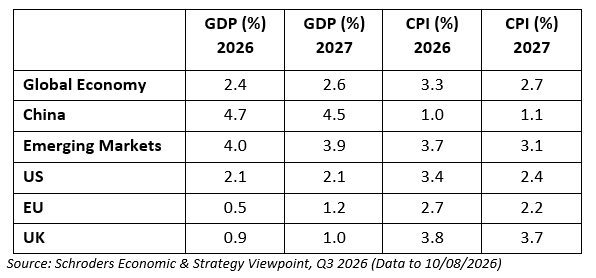
Growth continues to move forward. That is important. Growth might not be racing away, but a broad recession remains an outlier view. That is good.
In the US, there are positives to highlight. There is support from the strength of private-sector household and corporate balance sheets, continued fiscal expansion, and consumer spending has been resilient despite rising household and energy costs. There is also a strong US corporate capital-expenditure cycle underway and overall employment growth is stable.
Europe can also benefit from fiscal support, particularly from German military and infrastructure spending. The growth impact of which is likely to be a tailwind through to the end of the decade.
We cannot ignore the headwinds. US consumers may still be spending, but consumer confidence is falling as concerns over weak income growth, job security and high prices rise. Tax refunds gained earlier this year have helped to offset energy cost rises, whilst richer households have benefited from rising asset prices.
Europe has a genuine fiscal tailwind, particularly from German infrastructure spending, and recent activity data have improved. However, it is also highly sensitive to the energy shock because it is a net importer, gas storage is lower than usual for the time of year, and the system is facing its second major disruption in five years. The UK appears less robust: payroll growth and real wages are subdued, although investment may be improving.
Not already mentioned is China, where recent stimulus attempts look measured and seeking to stabilise growth rather than produce a decisive recovery. Consumer growth in China remains weak and its headwinds from falling property prices continue.
Emerging markets continue to offer stronger aggregate growth than developed economies, although the picture varies considerably between countries and according to their exposure to trade, commodities and inflation.
The global economy remains resilient, and recession is not the central case, but growth is modest, uneven and increasingly constrained by persistent inflation and higher energy costs.
Equity Markets – Working 9 to 5.
If you ignored the news headlines and looked only at the level of stock market indices, you might conclude that all was well with the world. So, with so many challenging headlines, how have equity markets kept rising?
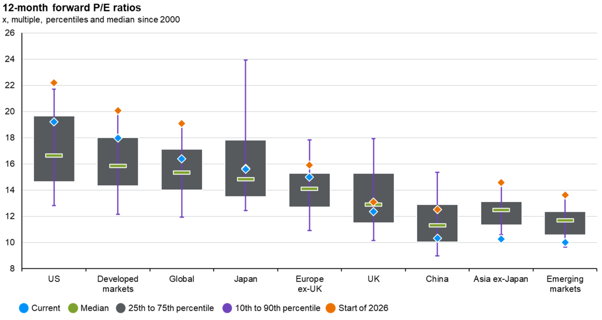
We have written about this previously, but if Vigil can make it to a third series, I’m giving myself a pass for being repetitive. The usual assumption that rising equity markets must mean rising valuations has not held this year. The earnings strength mentioned above has been remarkable and has been so strong that simple valuation metrics such as price/earnings ratios have fallen. According to FactSet, a provider of financial-market data, analysts expect the S&P 500 to deliver a third successive quarter of earnings growth above 25%, with calendar-year earnings growth forecast at almost 32%.
This strong earnings growth is not just a US phenomenon. The build-out of artificial intelligence has also benefited large semiconductor and memory companies in Asia and emerging markets. TSMC, Samsung, SK Hynix and MediaTek are significant constituents of both the MSCI Asia Pacific ex Japan and MSCI Emerging Markets indices, where strong earnings momentum has also helped to bring valuations lower.
Nor is the improving earnings picture solely related to AI. Encouragingly, growth has started to broaden beyond a narrow group of technology winners, both across the technology sector and between regions. Corporate balance sheets remain reasonably resilient overall, although the position varies considerably by company, sector and region. Increased refinancing needs are also likely to affect smaller and more highly leveraged companies sooner, particularly where they make greater use of floating-rate debt.
Whilst equity returns are working hard for portfolio returns this year, some caution is still warranted. Market valuations range broadly between country, sector and region, there is a reliance on continued AI-related investment and the inevitability that any geopolitical risks get felt most heavily in the equity part of portfolios.
Source: JPM Guide to the Markets, UK, 23rd September 2026
We continue to hold meaningful equity risk at a level that is appropriate for each risk profile. We also continue to maintain diversified portfolios, shying away from areas with the highest valuations. In summary, we are maintaining equity exposure because earnings remain supportive but diversifying because index concentration is high; whilst seeking to avoid the most expensive areas because expectations leave less tolerance for disappointment.
Fixed Income – The Bargain Store?
Whilst equity markets are rising strongly enough to win Bake Off, fixed income markets will be getting no handshake from Paul Hollywood this year.
Bond markets are usually the calmer waters, next to the more turbulent equity market. They tend to watch and wait, slowly moving yields higher or lower only once the wider economic or inflation trend becomes clearer. That is usually the case anyway, but signs this year are bond markets are increasingly agitated. The path of interest rates, real yields and inflation remain key drivers, but investors are also demanding higher compensation to fund the widening deficits of many developed-world governments. This has contributed to upward pressure on bond yields, particularly at longer maturities.
Returns from fixed income have been muted this year. This has been a headwind for lower-risk investors, who usually hold more in bonds and therefore rely more heavily on them to meet their long-term objectives. We believe that despite yields rising this year (and bond prices falling as a result), there remain good reasons to be positive about the potential in fixed income.
In some cases, headline yields have risen to multi-decade highs and with that, the longer-term return prospects from the asset class are rising too. A high starting yield is a very strong underpin to future fixed income returns.
Today, with yields around 5-6% for high-quality investment grade corporate bonds, the longer-term returns look sound from here. There are potential headwinds if rates move higher in the near-term, but some shelter (& still attractive levels of yield) can be found in shorter-dated fixed income funds.
The next phase for bond markets is likely to depend heavily on inflation. Much of that outlook will, in turn, be shaped by energy prices. If energy prices continue to rise, then the more central banks are likely to raise rates. The current prospects for a swift resumption of energy flows through some of the world’s troubled waters does not look likely. However, as we have seen, decisions can be taken that change the outlook very quickly. Any relief to the energy crisis will be swiftly welcomed.
In portfolios, we have therefore focused on capturing the income available from bonds while limiting exposure to larger price swings that can be driven by movements in interest-rate expectations. In practice, that means a greater emphasis on shorter-dated, higher-quality areas of the market, alongside a selective approach to credit risk.
While bonds may not be delivering showstopping returns today, higher yields are creating a much stronger recipe for future returns than investors have enjoyed for many years.
Widening the Investment Toolkit
At our most recent Investment Committee, we agreed to widen the range of investments available for your portfolio. This will not change your agreed objectives, risk profile or the service you receive. Alongside UK funds, we may now also invest in funds based in Ireland or Luxembourg, as well as exchange-traded funds. You can be reassured that every new investment will go through the same careful due diligence process. This extra flexibility will help us manage your portfolio effectively, while keeping our investment approach, controls and governance unchanged.
Conclusion: There Will Be Peace in the Valley
The global economy continues to expand, albeit at a modest pace. There remain risks for markets to navigate. The focus in the near term has been the challenge of rising energy prices, the impact this has on inflation, and the pressure this has on central banks to increase interest rates. We remain to be convinced that we are in a sustained, long-term cycle of rising interest rates.
Equity markets have been buoyed by strong earnings growth, particularly but not exclusively, in technology and energy sectors. Equity market valuations have become less expensive than at the start of the year. We continue to hold meaningful equity exposure where it is appropriate for each portfolio, while spreading exposure across regions, sectors and investment styles. We remain aware that valuations and expectations vary and remain cautious of increasingly concentrated market indices.
Fixed income has not delivered the kind of portfolio returns we had expected by this point of the year. Shifting interest rate expectations have been a headwind. However, fixed income yields remain attractive and should serve as an underpin to solid returns to come. We remain focused on good-quality areas, shorter-dated opportunities and a selective approach to credit risk.
Markets may continue to encounter periods of uncertainty and volatility. Whilst the months ahead may bring their share of challenges, we remain confident that patient, disciplined investors are well placed to benefit from the opportunities that emerge over time. Day-to-day headlines naturally focus attention on immediate risks, but, as Dolly said, eventually there will be peace in the valley.
Our message today is a familiar one: stay invested, stay diversified and avoid being pulled too far in either direction by the crowd. We aim to continue capturing the income available from bonds, hold enough equities to benefit from long-term growth, and maintain enough discipline to avoid chasing every passing theme.
In the meantime, Amaraj, Becky, Hayley, Kim, Will and I would like to thank you for continuing to trust us to manage your portfolio.